Module 6 · Project Manager Capstone: Rescue the Opening
The forecast
Turn week 10's progress into a forecast of the finish cost and the opening date, using the remaining work rather than a hopeful guess, and give the sponsor a range with a stated basis.
About 35 minutes
Open in ColabEvery example as a notebook you can run, edit and save to your Google Drive.
The problem
You know where the project stands: behind, and over budget. The sponsor's next question is "so what will it finish at?" There are two tempting answers, and both are wrong. One is to say "we'll catch up", which assumes the problems of the past ten weeks will vanish. The other is to extrapolate a single index across the whole project, which assumes everything will go as badly as the worst part has.
A good forecast starts from what's left to do, says how fast it's likely to go, and gives a range. For cost, EVM supplies standard estimates at completion. For the date, you re-run the schedule on the remaining work.
The concept
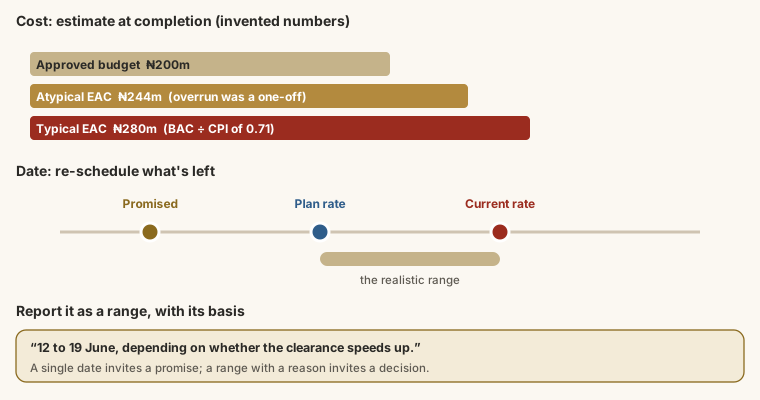
Forecasting the cost: estimate at completion (EAC)
Three common versions, each with an assumption:
| EAC | Formula | Assumes |
|---|---|---|
| Typical | BAC ÷ CPI | The rest of the project costs as much per unit of work as so far |
| Atypical | AC + (BAC − EV) | The overrun so far was a one-off; the remaining work costs what was budgeted |
| Re-estimate | AC + a new bottom-up estimate of the work remaining | You know more now and have redone the estimate |
The estimate to complete is ETC = EAC − AC, and the variance at completion is VAC = BAC − EAC (negative: over budget at the end). When CPI has been stable or falling, the typical EAC is the safer planning figure. The atypical one is the best case.
Forecasting the date: remaining work, re-scheduled
SPI isn't a date. To forecast the finish:
- Mark each finished task as done (zero remaining duration).
- For tasks in progress, estimate the remaining duration, either at the planned rate (the remaining percentage of the likely duration) or at the rate actually achieved so far (elapsed days ÷ percent done × percent left).
- Leave tasks not started at their likely duration.
- Run the critical path on what's left, and add the result to today's date (day 50).
The planned-rate forecast is the hopeful end of the range. The current-rate forecast is the realistic one when a task has genuinely been slower than planned.
Example
Set up, with the schedule function from lesson 3:
Edit the code and press Run (Ctrl + Enter). Examples on this page share their variables, like cells in a notebook.
The cost forecasts first:
Edit the code and press Run (Ctrl + Enter). Examples on this page share their variables, like cells in a notebook.
Output
BAC:                ₦90,750,000
Typical EAC (BAC/CPI): ₦120,337,860   over by ₦29,587,860 (33%)
Atypical EAC: ₦107,924,000 over by ₦17,174,000 (19%)Even the hopeful case is ₦17m over budget because the overrun already happened. If the remaining work costs as much per unit as the work so far, the project finishes ₦29.6m over, a third more than the sponsor approved. Neither includes a naira of the changes the sponsor is being asked to consider.
Now the date. Work out each task's remaining duration at the two rates, then reschedule what's left:
Edit the code and press Run (Ctrl + Enter). Examples on this page share their variables, like cells in a notebook.
Output
At the plan rate: 49.2 days of work left, opening on 2027-03-19 (9 working days after the promise)
At the current rate: 54.7 days of work left, opening on 2027-03-26 (14 working days after the promise)Whichever rate you take, the promised date is gone: the opening is somewhere between Friday 19 March and Friday 26 March, 9 to 14 working days after the promise. The critical chain is unchanged (analyser import, installation, reagents, validation, inspection, trial run), and it starts with the one task that is behind.
Edit the code and press Run (Ctrl + Enter). Examples on this page share their variables, like cells in a notebook.
Output
Critical now: B4 -> B5 -> E2 -> F1 -> F2 -> F3 -> F4Walkthrough
- Set up the schedule function, BAC, EV, AC and CPI as in lesson 5.
- Calculate the typical and atypical EAC, and the variance at completion for each.
- Calculate each task's remaining duration at the planned rate.
- Re-run the schedule on the remaining durations, and add the result to day 50.
- Repeat at the current rate.
- Compare each forecast with the promised day.
- Write the forecast for the sponsor (the task below).
Practice
Practice
What is the typical EAC (BAC ÷ CPI), rounded to the nearest naira?
Practice
If the remaining work goes at the planned rate, on what date does the project finish? Type it as YYYY-MM-DD.
Practice
At the current rate, how many working days after the promised day does the project finish?
Task
12 minWrite the forecast for the sponsor (80 to 170 words): the opening date range and its basis, the cost forecast with the assumption behind each version, how far the promised date is missed, and what you'd not want them to assume.
Your work is checked for
- Gives a date range (19 to 26 March)
- Gives the upper date (26 March)
- Says the promised date is missed
- Gives a cost forecast (107.9 or 120.3 million)
- States an assumption (rate, one-off, CPI)
- Says what not to assume (catch up, no changes)
- Between 80 and 170 words
Check your understanding
Answer every question to check.