Module 3 · Project Manager Capstone: Rescue the Opening
The critical path
Build the baseline schedule with the critical path method, find the 11 tasks that decide the opening date and the ones with room to slip, and see how little cushion the promised date really had.
About 30 minutes
Open in ColabEvery example as a notebook you can run, edit and save to your Google Drive.
The problem
Twenty-three tasks, each owner pushing to finish theirs. But they don't all matter equally for the opening date. Hiring staff can slip by weeks without delaying anything; one day lost importing the analysers delays the opening by one day. A project manager who treats every task alike spends effort in the wrong places, and a sponsor who hears "everything is a priority" learns nothing.
The managing director promised Monday 8 March 2027. Before you ask how late the project is, you need to know where the plan itself put the finish. Was the promised date ever safe?
The concept
The critical path method
- Forward pass. A task's earliest start is the latest earliest-finish of everything it depends on. Earliest finish = earliest start + duration. The project's length is the last earliest finish.
- Backward pass. Working back from the end, a task's latest finish is the earliest latest-start of the tasks that depend on it.
- Float (slack) = latest start − earliest start: how long a task can slip without delaying the end.
- The critical path is the chain of tasks with zero float. Any delay on it delays the project.
Durations are in working days. Convert to dates with a working calendar (Monday to Friday here; a real plan would also remove public holidays).
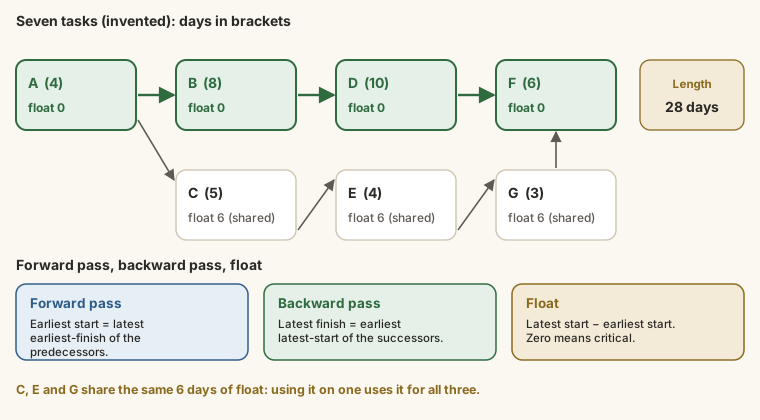
Float is not free time
A task with float can slip, but it uses up the float, and other tasks may share the same float. Two tasks with 8 days of float each, in the same chain, don't give you 16.
Example
A scheduling function you'll reuse in later lessons:
Edit the code and press Run (Ctrl + Enter). Examples on this page share their variables, like cells in a notebook.
Output
Project length: 90 working days, opening on 2027-03-05
Critical path: A1 -> A2 -> B1 -> B3 -> B4 -> B5 -> E2 -> F1 -> F2 -> F3 -> F4The baseline finishes on Friday 5 March 2027: day 90. The promise is for Monday 8 March, day 91. The plan left one working day of cushion, and that was before anything went wrong.
Edit the code and press Run (Ctrl + Enter). Examples on this page share their variables, like cells in a notebook.
Output
Promised date is working day 91 - cushion: 1 working day(s)
    es  ef  float                                         name
A1   0   3      0            Approve business case and charter
A2   3  11      0                  Sign lease for the premises
B1  11  19      0        Design the lab layout and clean areas
B3  19  25      0                          Order the analysers
B5  50  57      0          Install and calibrate the analysers
B4  25  50      0               Import and clear the analysers
E2  57  63      0               Stock reagents and consumables
F1  63  75      0  Validate the methods and run quality checks
F2  75  83      0   Pass the external accreditation inspection
F3  83  89      0              Trial run with sample specimens
F4  89  90      0                                  Opening day
B2  19  47      3      Fit-out: floors, power and air handling
B6  47  55      8        Install backup power and cold storage
C5 57 63 12 Test the system with the analysersEleven tasks have zero float. Look at what they are: the premises, the layout, ordering and importing the analysers, installing them, stocking reagents, validating the methods, the inspection, the trial run and the opening. The long-lead imported equipment runs the whole project, not the fit-out, which has 3 days of float, and not hiring, which has 30.
Walkthrough
- Define
schedule()andfinish_date(). - Build the baseline from likely durations. Note the length and the finish date.
- Compare the finish with the promised date, in working days.
- List the zero-float tasks, and read each one's owner.
- Look at the tasks with the most float. Which owners are working hardest on things that don't matter this month?
- Write the baseline schedule note (the task below).
Practice
Practice
On what date does the baseline schedule finish? Type it as YYYY-MM-DD.
Practice
How many tasks are on the critical path (zero float)?
Practice
How many days of float does task D1 (hire the laboratory director) have?
Task
10 minWrite the baseline schedule note for the sponsor (60 to 150 words): the baseline finish date, how it compares with the promised date, which kind of tasks are critical and which have the most float, and what that means for where you'll spend your attention.
Your work is checked for
- Gives the baseline finish (5 March)
- Compares with the promised date (8 March)
- Says the cushion is tiny (one day)
- Names critical activities (analysers, installation, inspection...)
- Names a high-float activity (hiring, systems)
- Says where attention goes (critical path)
- Between 60 and 150 words
Check your understanding
Answer every question to check.