Module 4 · Project Manager Capstone: Rescue the Opening
How sure are we?
Run a Monte Carlo simulation over the plan's three-point estimates, find the real chance of the promised date, and turn P50 and P80 dates into a reserve the sponsor can decide on.
About 30 minutes
Open in ColabEvery example as a notebook you can run, edit and save to your Google Drive.
The problem
The baseline said Friday 5 March, one working day before the promise. But that date is a single path through a plan whose tasks vary a great deal. Some tasks overrun far more than they underrun, and when several paths run in parallel, the project finishes when the slowest one does. That makes the real finish later than any single estimate suggests.
The managing director doesn't need a date. They need to know how likely the promised date is, and what date they could commit to if they wanted to be reasonably sure. Both come from simulation.
The concept
Monte Carlo simulation
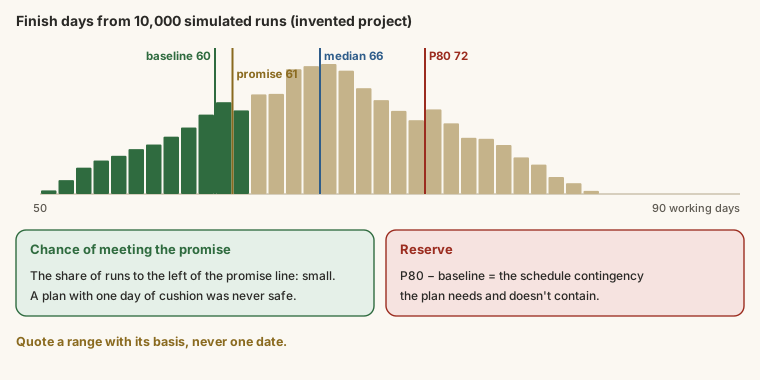
For each of thousands of runs, draw a duration for every task from a distribution shaped by its three estimates (a triangular distribution: minimum, most likely, maximum), run the schedule, and record the finish. After 10,000 runs you have 10,000 possible finish days. The spread tells you how uncertain the plan is.
From the results you can read:
- The chance of meeting a date: the share of runs that finish by it.
- P50: the day half the runs beat. A coin toss.
- P80: the day 80% of runs beat. A date you could commit to with reasonable confidence.
- The reserve: the gap between the baseline and P80, which is the schedule contingency the plan needs and doesn't have.
Why the simulated finish is later than the plan
Take two parallel paths of equal length. Each has a 50% chance of finishing on time. The project is on time only when both do: about 25%. A project with many near-critical paths loses more still. This is the "merge bias" of project networks, and it's why a plan built on likely durations is almost always optimistic.
Example
Reload the plan, then simulate. This version draws all the durations at once and works through the tasks in order, so 10,000 runs take a moment:
Edit the code and press Run (Ctrl + Enter). Examples on this page share their variables, like cells in a notebook.
Output
Mean finish: day 103.6
Chance of finishing by day 91: 2.8%
P50: day 103.4
P80: day 109.6
P90: day 112.9On the plan's own estimates, the chance of making the promised date was under 3%. The date was never likely, and it was promised before the plan was simulated. Convert the P50 and P80 days to dates:
Edit the code and press Run (Ctrl + Enter). Examples on this page share their variables, like cells in a notebook.
Output
Baseline: 2027-03-05
P50:      2027-03-25
P80:      2027-04-02
Reserve needed for P80: 20 working daysA date the sponsor could commit to with 80% confidence is Friday 2 April, about 20 working days after the baseline. And this is the plan from before week 10. Nothing in this lesson knows yet that the analysers are stuck in customs. That's lesson 5.
Walkthrough
- Define
simulate()and run it for 10,000 runs with seed 42. - Calculate the probability of finishing by day 91.
- Calculate P50, P80 and P90, and convert them to dates.
- Calculate the reserve in working days between the baseline (day 90) and P80.
- Plot the finish days as a histogram with the baseline, the promise and P80 marked (optional, but sponsors remember pictures).
- Write the schedule risk note (the task below).
Practice
Practice
In the simulation, what is the chance of finishing by the promised date (day 91)? As a percentage, whole number.
Practice
What is the P80 finish, rounded up to a whole working day?
Practice
On what date is the P50 finish? Type it as YYYY-MM-DD.
Task
10 minWrite the schedule risk note for the sponsor (70 to 160 words): the chance of making the promised date, the P50 and P80 dates, the reserve the plan needs, why a single date is misleading, and what you'd ask them to decide.
Your work is checked for
- Gives the chance of the promised date (about 3%)
- Gives the P50 date (25 March)
- Gives the P80 date (2 April)
- States the reserve (about 20 days)
- Says a single date misleads (uncertainty, many paths)
- Asks for a decision
- Between 70 and 160 words
Check your understanding
Answer every question to check.