Module 7 · Project Manager Capstone: Rescue the Opening
Risks and change requests
Put a price and a delay on the risk register, find which risks actually sit on the critical chain, and judge six change requests by what they do to the forecast, not by what the request says.
About 35 minutes
Open in ColabEvery example as a notebook you can run, edit and save to your Google Drive.
The problem
Two piles of paper have landed on the sponsor's desk. One is the risk register: thirteen things that might go wrong, each with a probability and an impact. The other is six change requests raised in weeks 9 and 10, each with a number of "extra days" and an extra cost. The sponsor wants to know how much reserve to hold, and which requests to approve.
Both are easy to get wrong. A risk register is often read as a list of worries; it should be read as a budget and a schedule allowance. And the extra days on a change request are rarely the days it adds to the project: that depends on where in the plan the change lands.
The concept
Risk: expected monetary value and expected delay
For each open risk:
- EMV (expected monetary value) = probability × cost impact.
- Expected delay = probability × delay in working days.
Add the EMVs for the cost contingency the project should hold. The expected delay of risks that sit on the critical chain is the schedule contingency. A risk on a task with float costs money if it happens but may not delay the opening at all.
Contingency isn't padding. It's an honest figure, held by the sponsor and released against named risks.
Responses
For each risk the owner chooses a response: avoid it, reduce it (cheaper insurance, a second supplier), transfer it (insurance, a contract), or accept it knowingly. A response is worth buying when it costs less than the EMV it removes.
Change requests
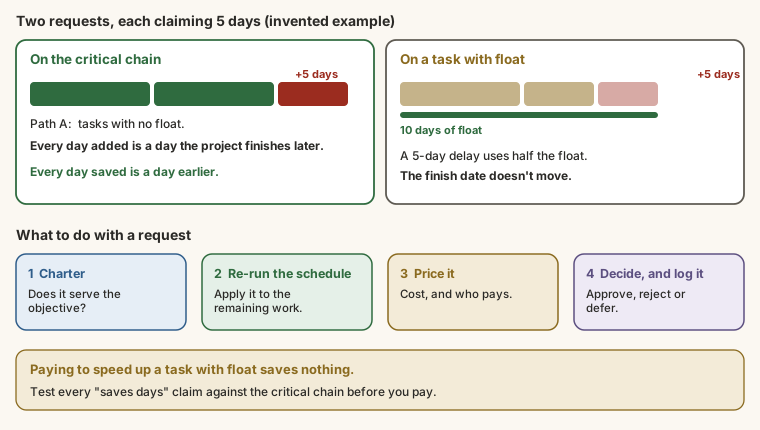
A change request is a proposal to alter scope, time or cost. Every change goes through the same check:
- Does it serve the charter's objective? If not, it needs its own business case.
- What does it do to the date? Re-run the forecast schedule with the change applied. The days on the request are not the days added: if the affected task has float, it may add nothing; if it's on the critical chain, it adds all of it.
- What does it cost, and who pays?
- Decide: approve, reject, or defer with a condition, and record it.
Example
Set up the schedule function and the remaining-work durations from lesson 6. The float is rounded before testing for zero, because fractional remaining durations leave tiny floating-point crumbs:
Edit the code and press Run (Ctrl + Enter). Examples on this page share their variables, like cells in a notebook.
Output
Forecast: day 104.7
Critical chain: B4 -> B5 -> E2 -> F1 -> F2 -> F3 -> F4The critical chain now starts at the analyser import. Now price the risk register:
Edit the code and press Run (Ctrl + Enter). Examples on this page share their variables, like cells in a notebook.
Output
Open risks: 12
Cost contingency (total EMV): ₦15,030,000
risk_id                                               description       emv
    R02   Naira weakens further, raising imported equipment costs 3500000.0
    R10 Opening misses the ministry's date, with public criticism 3500000.0
    R01          Customs holds the analysers longer than expected 2500000.0
R06 Grid power too unreliable for the analysers 1750000.0Thirteen risks, but only twelve are open (one has been closed). The total EMV is ₦15m, which is the cost contingency the project should hold on top of the forecast. The two biggest items are the naira (a cost risk with no delay) and missing the date (a reputational one).
Which of the delay risks are on the critical chain? Link each to the task it threatens:
Edit the code and press Run (Ctrl + Enter). Examples on this page share their variables, like cells in a notebook.
Output
risk_id task  expected_days
    R01   B4            6.0
    R03   B5            2.0
    R04   F2            4.5
    R09   E2            1.4
Expected delay on the critical chain: 13.9 working days
Expected delay on tasks with float: 7.5 working days (absorbed by float)Of about 21 days of expected delay in the register, only 13.9 sit on the critical chain. The rest are on tasks with float: they'll cost money if they happen but they mostly won't move the opening. That's the schedule contingency, and it's on top of the forecast.
Now the change requests. Apply each one to the remaining-work schedule and see what it does to the finish:
Edit the code and press Run (Ctrl + Enter). Examples on this page share their variables, like cells in a notebook.
Output
id                                      request  days_on_form  change_to_finish  extra_cost_ngn
CR1 Add a molecular testing room with its own ai            14              0.25        16000000
CR2 Hire 3 more phlebotomists for longer collect             0              0.00         2100000
CR3 Pay the contractor for weekend working on th            -5              0.00         3200000
CR4 Upgrade the information system to include a              6              0.00         4800000
CR5     Ship the analysers by air instead of sea            -9             -9.00         5500000
CR6 Add a home-collection van and route software 0 0.00 3600000Look at the column the request forms don't show. CR5 (ship the analysers by air) really does pull the finish in by 9 days, because it lands on the critical task. CR3 (weekend working on the fit-out) claims 5 days and delivers none: the fit-out is nearly finished and isn't on the critical chain. CR1 (the molecular room) claims 14 extra days, but because the fit-out has float it adds a quarter of a day to the forecast. That doesn't make it cheap: it costs ₦16m, and the model doesn't know the new room also needs its own installation and validation. CR2, CR4 and CR6 don't touch the critical chain at all and are about money and scope, not time.
Walkthrough
- Set up the schedule, the remaining durations and the baseline forecast.
- Calculate EMV and expected delay for every open risk, and the total EMV.
- Link each delay risk to its task, and find which sit on the critical chain.
- Calculate the expected delay on the critical chain.
- Apply each change request to the remaining-work schedule and record its effect on the finish.
- For each request, decide: approve, reject or defer, with a reason.
- Write the decision note (the task below).
Practice
Practice
What is the total EMV of the open risks (probability × cost impact, summed), in naira?
Practice
What is the expected delay on the critical chain from the open risks, in working days? One decimal place.
Practice
How many working days earlier does the project finish if CR5 (air freight) is approved?
Practice
How many of the six change requests move the finish date by at least one working day, either way?
Task
14 minWrite the decision note on the six change requests (90 to 200 words). For each (CR1 to CR6) say approve, reject or defer with a one-line reason based on its effect on the date, its cost and the charter. State which one you recommend approving.
Your work is checked for
- Covers CR1
- Covers CR3 and says it doesn't help the date
- Covers CR5 and recommends it
- Covers CR2, CR4 or CR6
- Uses approve/reject/defer language
- Refers to the critical chain or the date
- Refers to the cost or the charter
- Between 90 and 200 words
Check your understanding
Answer every question to check.