Module 1 · Project Manager Capstone: Rescue the Opening
The brief and the charter
Meet Medlink Diagnostics, whose laboratory opening is in trouble, turn a sponsor's worry into a charter with scope, success criteria and constraints, and map the stakeholders you'll have to bring along.
About 40 minutes
Open in ColabEvery example as a notebook you can run, edit and save to your Google Drive.
The problem
This is the capstone of the Project Manager track. There are no new techniques here. You'll do what a project manager is hired to do when a project is in trouble: find out where it really stands, say how late and how dear it will be, weigh the changes and recovery options on the table, and give the sponsor a decision they can act on.
The company is Medlink Diagnostics, a private laboratory group. It is opening a diagnostic laboratory in Port Harcourt, and its managing director has made a public promise. You've been brought in as project manager at the end of week 10. This is the email you find:
"We told the state commissioner that the laboratory would open on Monday 8 March 2027. We are in week 10. The analysers are stuck in customs, the naira has moved against us, and I keep being asked for extras: a molecular room, a patient portal, a home-collection van. I don't know whether the date is safe, what it will cost, or which of these requests I should say yes to. I need a plan I can take to the board."
Notice what the email contains: a promised date, a feeling that something is wrong, and a pile of requests. It doesn't contain a status, a forecast or a decision. Your job is to produce all three, with evidence.
You have the project's own records: the task plan, ten weeks of progress and spending, the risk register, six change requests, eight stakeholders' views and six recovery options. All of it is fictional.
The concept
The arc of the project
| Stage | Output | Lesson |
|---|---|---|
| Brief and charter | Objective, scope, constraints, stakeholders | 1 |
| Scope, WBS and estimates | A checked plan with honest durations and cost | 2 |
| The critical path | The baseline schedule and what decides the date | 3 |
| Schedule risk | The probability of the promised date | 4 |
| Where are we now | Earned value at week 10 | 5 |
| The forecast | Likely finish date and cost | 6 |
| Risks and change requests | Reserves, and which changes to accept | 7 |
| Recovery and the decision paper | A recommended recovery, reported to the sponsor | 8 |
Use Python, Excel or a mix. The lessons show Python because it handles the schedule and the simulation cleanly; every number can be reproduced in a spreadsheet.
A charter says what the project is for
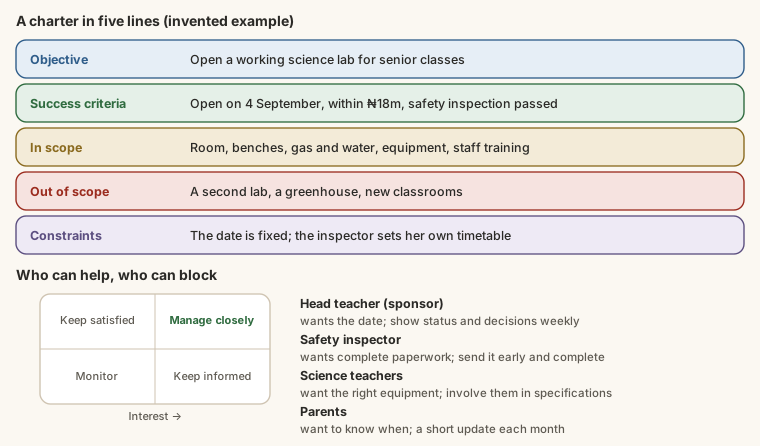
A project charter is short, and it's agreed by the sponsor. It answers:
- Objective: what the project will deliver, in one sentence a stakeholder could repeat.
- Success criteria: how anyone will know it worked, with numbers and a date.
- Scope: what is in, and, just as important, what is out.
- Constraints: the date, the budget, the rules that can't bend.
- Key stakeholders and the sponsor's authority: who decides what.
Without it, every request sounds reasonable, and nobody can say no.
Stakeholders: who can help, who can block
Plot each stakeholder by influence and interest. Manage closely those high on both, keep satisfied those with high influence but less interest, keep informed those with high interest but less influence, and watch the rest. Then record what each one cares about, because it tells you how to talk to them. The licensing office cares about complete paperwork, not about your date.
Example
Open the project's tasks and stakeholders:
Edit the code and press Run (Ctrl + Enter). Examples on this page share their variables, like cells in a notebook.
Output
23 tasks in 7 phases
phase
Equipment     3
Facilities    3
Initiation    3
Launch        4
Operations    2
People        3
Systems 5The plan has 23 tasks in 7 phases. Each task has an owner, three duration estimates (optimistic, likely and pessimistic), its predecessors and a daily cost. The approved budget is the likely duration times the daily cost, added up:
Edit the code and press Run (Ctrl + Enter). Examples on this page share their variables, like cells in a notebook.
Output
Approved budget (BAC): ₦90,750,000Now the stakeholders, by influence and interest:
Edit the code and press Run (Ctrl + Enter). Examples on this page share their variables, like cells in a notebook.
Output
influence  interest
High       High                              Managing director (sponsor)
           Low                                          Licensing office
           Medium      State commissioner for health; Chief financial...
Low        Medium                                Local community leaders
Medium High Medical director; Head of procurement; Laborat...The managing director and the commissioner don't sit in the same box. The sponsor is high on both; the commissioner has high influence but only medium interest in the details, so a short, regular, public-facing update suits them better than a weekly project call.
Walkthrough
- Load the six files (
tasks,weekly_status,risks,changes,stakeholdersandoptions) and note each one's grain: one row per task, per task per week, per risk, per change request, per stakeholder, per option. - Check the task list: every task has an owner, and every predecessor named exists as a task.
- Calculate the approved budget.
- Group the stakeholders by influence and interest, and read each one's quote.
- Write the charter and the stakeholder strategy (the tasks below).
Practice
Practice
What is the approved budget (the sum of likely days × daily cost over all tasks), in naira?
Practice
How many stakeholders are high on both influence and interest?
Task
12 minWrite the project's charter (80 to 180 words): the objective, the success criteria (a date and the budget), what is in scope and out of scope, and the main constraints. Don't mention any solution to the delay; you haven't earned one yet.
Your work is checked for
- States an objective (open a laboratory)
- Gives the date
- Gives the budget
- Says what is in scope
- Says what is out of scope
- Names a constraint
- Between 80 and 180 words
Task
10 minWrite a stakeholder strategy (60 to 150 words) for three of them: the managing director, the licensing office and the medical director. For each, say how you'll engage them and what you'll give them, based on what they care about.
Your work is checked for
- Covers the managing director / sponsor
- Covers the licensing office
- Covers the medical director
- Says how often or how to engage
- Ties it to what they care about
- Between 60 and 150 words
Check your understanding
Answer every question to check.