Module 2 · Project Manager Capstone: Rescue the Opening
Scope, WBS and estimates
Check the plan you've inherited for gaps, turn three-point estimates into honest expected durations and costs with PERT, and see why the approved budget was never as safe as it looked.
About 30 minutes
Open in ColabEvery example as a notebook you can run, edit and save to your Google Drive.
The problem
The plan you've inherited has 23 tasks, and the approved budget is the likely duration times the daily cost, added up. But "likely" is the single most probable duration, not the average. Most tasks can overrun far more than they can underrun: a licence that "usually takes 22 days" can take 45, and it can't take 5. Budgets and dates built from likely values are optimistic by design.
Before you test the plan against reality, check it's a plan at all: every task owned, every dependency real, nothing missing. Then replace likely values with expected ones.
The concept
A work breakdown structure you can check
A work breakdown structure (WBS) divides the project into phases and tasks so that everything in scope appears once and nothing outside it appears at all. Here the phases are Initiation, Facilities, Equipment, Systems, People, Operations and Launch. Check:
- Every task has one owner, a team answerable for it.
- Every predecessor named exists, and no task depends on itself or on a later task.
- Every deliverable in the charter has a task: licence, premises, analysers, system, staff, reagents, accreditation, opening.
- Nothing is in the plan that isn't in scope. A task that has crept in is a change that skipped change control.
Three-point estimates and PERT
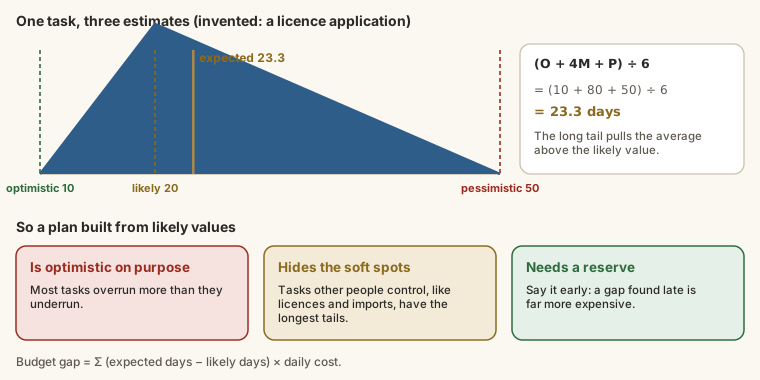
Each task has an optimistic (O), likely (M) and pessimistic (P) duration. The PERT approximation gives:
- Expected duration = (O + 4M + P) ÷ 6
- Standard deviation = (P − O) ÷ 6
Because P is usually further from M than O is, the expected duration is longer than the likely one. The more skewed a task, the bigger the gap. Where estimates are skewed, a plan built on likely values is a plan with no room for the way the world works.
Cost follows duration
Here each task costs a fixed amount per working day, so the expected cost of a task is its expected duration times its daily cost. Add them up and compare with the approved budget. The difference is the first thing a sponsor should know: it's the money the plan needs but doesn't contain.
Example
Check the plan's integrity first:
Edit the code and press Run (Ctrl + Enter). Examples on this page share their variables, like cells in a notebook.
Output
Unknown predecessors: []
Tasks without an owner: 0
Tasks per owner:
owner
IT             5
Operations     4
Procurement    3
Contractor     3
HR             2
Laboratory     2
Regulatory     2
Board          1
Facilities 1No gaps. Now the expected durations and costs:
Edit the code and press Run (Ctrl + Enter). Examples on this page share their variables, like cells in a notebook.
Output
task_id  likely_days  expected_days  sd_days
     A3           22           24.7      5.0
     B4           25           27.2      4.5
     B2           28           29.8      3.8
     D1           22           23.0      3.3
     D2           20           20.8      2.5

Approved budget (likely):  ₦90,750,000
Expected cost (PERT):      ₦96,304,167
Gap: ₦5,554,167The budget was set on the most likely case. Expected cost is about ₦5.6m higher, before a single risk has been counted. A sponsor who approved ₦90.75m was approving a number that has less than an even chance of being enough.
The most skewed tasks are the ones controlled by other people: the facility licence (up to 45 days), importing the analysers (up to 45) and the accreditation inspection (up to 20). Those are also the ones you can't speed up by working harder.
Walkthrough
- Check the plan: unknown predecessors, missing owners, tasks per owner.
- Calculate expected duration and standard deviation for every task.
- Calculate the expected cost, and compare it with the approved budget.
- Find the tasks where the pessimistic estimate is at least twice the likely one. These are the plan's soft spots.
- Write up what the sponsor should be told about the budget (the task below).
Practice
Practice
What is the project's expected cost (PERT expected days × daily cost, summed over all tasks), rounded to the nearest naira?
Practice
How many tasks have a pessimistic duration of at least twice the likely duration?
Practice
Which task has the biggest gap between its expected and likely duration? Type its ID.
Task
10 minWrite a note to the chief financial officer (60 to 150 words) about the budget: say what the approved budget is based on, what the expected cost is and the gap, which tasks are the soft spots and why, and what you'll do about it.
Your work is checked for
- States the approved budget
- States the expected cost
- States the gap (about 5.5 or 5.6 million)
- Says the budget was based on likely values
- Names a soft-spot task or activity
- Says what you'll do (reserve, decision, track)
- Between 60 and 150 words
Check your understanding
Answer every question to check.