Module 8 · Project Manager Capstone: Rescue the Opening
Recovery and the decision paper
Test six recovery options against the forecast, find the combinations that bring the opening back, choose with the sponsor's priorities in mind, and write the one-page paper that asks for the decisions you need.
About 65 minutes
Open in ColabEvery example as a notebook you can run, edit and save to your Google Drive.
The problem
You now have a status (behind and over budget), a forecast (19 to 26 March, over by ₦17m to ₦30m), a priced risk register and a view of six change requests. The sponsor has one more question: what should we do? Six recovery options are on the table, and they interact. Some save days on the critical chain; some save none; some can be combined; one needs the medical director's agreement and changes what the laboratory opens with.
A recovery plan isn't "work harder". It's a short list of actions, each with a cost and a measured effect on the date, plus a clear account of what the sponsor must decide and by when.
The concept
Three ways to recover time
| Technique | What it means | Here |
|---|---|---|
| Crashing | Pay more to shorten a task | Air freight for the analysers; weekend shifts |
| Fast-tracking | Do things in parallel that were planned in sequence | Stock reagents while the analysers are installed |
| Reducing scope | Do less, or defer part of it | Open with the most-requested tests; validate the rest after opening |
All of them cost something: money, risk, or quality. And all of them only help on the critical chain.
Choosing
Compare options on:
- Days saved on the forecast, measured by re-running the schedule, not read from the proposal.
- Extra cost.
- What it puts at risk: quality, safety, the full test menu, the regulator's trust.
- Whether the sponsor's priorities allow it. Here the managing director wants the date; the medical director won't open without the full menu; the CFO won't be surprised again.
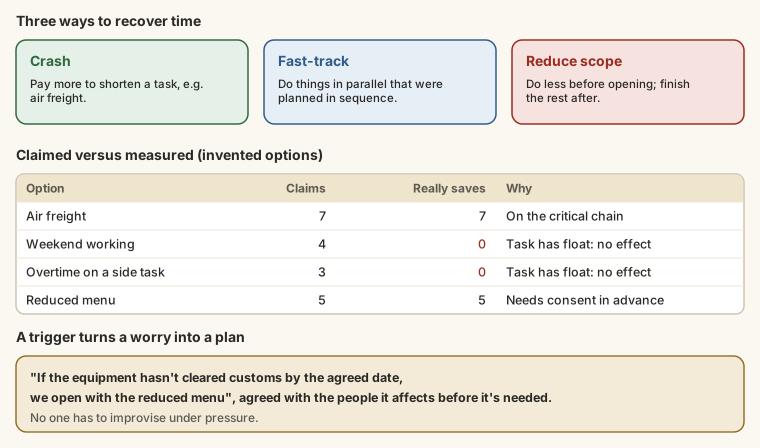
Where no combination is safe, say so, and say what you'd do if the next problem arrives. A trigger ("if clearance isn't complete by 20 January, we use the reduced menu") turns a worry into a plan.
The decision paper
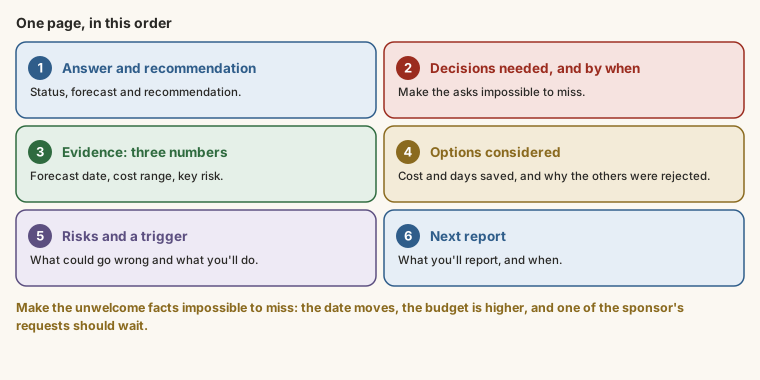
One page for the sponsor, in this order:
- The answer: status, forecast and what you recommend, in two sentences.
- What you need decided, and by when.
- Evidence: the three numbers that matter (forecast date, cost, risk).
- Options considered, with cost and days saved, and why the others were rejected.
- Risks and triggers.
- What you'll report next, and when.
Example
Set up the forecast as in lesson 6, then apply each recovery option to the remaining-work schedule:
Edit the code and press Run (Ctrl + Enter). Examples on this page share their variables, like cells in a notebook.
Output
Forecast with no action: day 104.7, 2027-03-26
option_id                             option  extra_cost_ngn  days_saved
       O1                Carry on as planned               0           0
       O2               Fly the analysers in         5500000           9
       O3     Weekend working on the fit-out         3200000           5
       O4       Start reagent stocking early          450000           4
       O5      Open with a reduced test menu         1200000           6
O6 Add a molecular testing room first 16000000 -14An option's "days saved" is what the proposer claims, and it only counts if it lands on the critical chain. Link each option to the task it changes, apply it, and measure:
Edit the code and press Run (Ctrl + Enter). Examples on this page share their variables, like cells in a notebook.
Output
O2: claims 9 days, really saves 9.0
O3: claims 5 days, really saves 0.0
O4: claims 4 days, really saves 4.0
O5: claims 6 days, really saves 6.0O3, weekend shifts on the fit-out, claims 5 days and saves none, as in lesson 7. The other three are real. Now try every combination of the four recovery options:
Edit the code and press Run (Ctrl + Enter). Examples on this page share their variables, like cells in a notebook.
Output
options  finish_day       date  extra_cost_ngn
O2 + O4 + O5        85.7 2027-03-01         7150000
     O2 + O5        89.7 2027-03-05         6700000
     O2 + O4        91.7 2027-03-09         5950000
     O4 + O5        94.7 2027-03-12         1650000
          O2        95.7 2027-03-15         5500000
O5 98.7 2027-03-18 1200000The cheapest way to meet the promised day (91) is O2 + O5: air freight and a reduced opening menu, for ₦6.7m, opening on 5 March. Adding O4 takes it back to 1 March, for ₦0.45m more. O2 + O4 alone, with the full test menu, opens on Tuesday 9 March, one working day after the promise, for ₦5.95m.
That's the real decision. Meeting the promise to the day needs the reduced menu, which the medical director has said he won't accept without a clinical case; the full menu costs one day, and the sponsor has to decide whether to take that to the commissioner.
And none of those dates includes the risk register. The expected delay on the critical chain is 13.9 days (lesson 7), so a plan that opens on 9 March with no allowance is a plan with perhaps a 20% chance of doing so. The honest recommendation has three parts:
- Approve O2 and O4 now. They keep the full menu, cost ₦5.95m, and bring the forecast to 9 March.
- Keep O5 as a trigger, not a plan. If the analysers have not cleared customs by a named date, use the reduced menu to protect the opening, with the medical director's agreement settled in advance.
- Tell the commissioner now that the opening will be in the week of 8 March, with a realistic range, instead of letting the date go quietly wrong.
The cost position follows:
Edit the code and press Run (Ctrl + Enter). Examples on this page share their variables, like cells in a notebook.
Output
Approved budget:           ₦90,750,000
Forecast with recovery:    ₦113,874,000 to ₦126,287,860
Opening with recovery: 2027-03-09Walkthrough
- Rebuild the forecast with no action and note its day and date.
- Link each recovery option to the task it changes, and measure its real effect.
- Try every combination, and list finish date and cost.
- Mark which combinations meet the promised day, and what each one puts at risk.
- Choose, with reasons, and name a trigger for the option you're holding back.
- Calculate the revised cost range.
- Write the decision paper (the first task below), and the answers to the sponsor's hardest questions (the second).
Practice
Practice
If O2 and O4 are both approved, on what date does the project finish? Type it as YYYY-MM-DD.
Practice
What is the cheapest combination of the four recovery options (O2 to O5) that finishes by the promised day (day 91)? Give its extra cost in naira.
Practice
How many of the four recovery options O2 to O5 actually shorten the finish when applied alone?
Practice
With O2 and O4 approved, what is the upper end of the cost forecast (typical EAC plus the options' cost), to the nearest naira?
Task
20 minWrite the decision paper for the sponsor (150 to 280 words), in this order: the answer and recommendation first, the decisions you need and when, the evidence (forecast date, cost and risk), the options considered and why the others were rejected, and the trigger for the contingency plan.
Your work is checked for
- Leads with a recommendation
- Says the promised date will be missed or at risk
- Recommends O2 (air freight)
- Recommends O4 (reagents early)
- Gives the forecast date (9 March)
- Gives a cost (₦5.95m, 113.9 or 126.3m)
- Rejects or holds back an option (weekend working, molecular room, reduced menu)
- Names a trigger
- Between 150 and 280 words
Task
12 minWrite the answers to the sponsor's three hardest questions (100 to 200 words in all): "Why can't we just keep 8 March?", "Why not approve the weekend working?" and "Why shouldn't I add the molecular room now?"
Your work is checked for
- Answers the 8 March question (critical chain, no cushion, probability)
- Answers the weekend working question (not critical, saves nothing)
- Answers the molecular room question (cost, days, scope, business case)
- Uses a number from the analysis
- Between 100 and 200 words
Check your understanding
Answer every question to check.