Module 1 · Data Modelling
What is a data model?
Why data needs a design before it needs a dashboard, and the three levels a model moves through - conceptual, logical and physical.
About 20 minutes
The problem
Kolanut's first "database" was one enormous spreadsheet: every order with the customer's name, city, phone number and sales rep typed in again on each row. When a customer moved from Kano to Abuja, their old orders still said Kano and their new ones said Abuja. Nobody could say how many customers Kolanut had, because "Peace Provisions" and "Peace Provision" were counted as two.
The data wasn't wrong because people were careless. It was wrong because nobody had designed it.
The concept
A data model is the design of how data is organised: what things are stored, what is known about each, how they connect, and what rules they follow. It's the plan you build a database (or a Power BI model) from.
Models are usually described at three levels, from business language down to database detail:
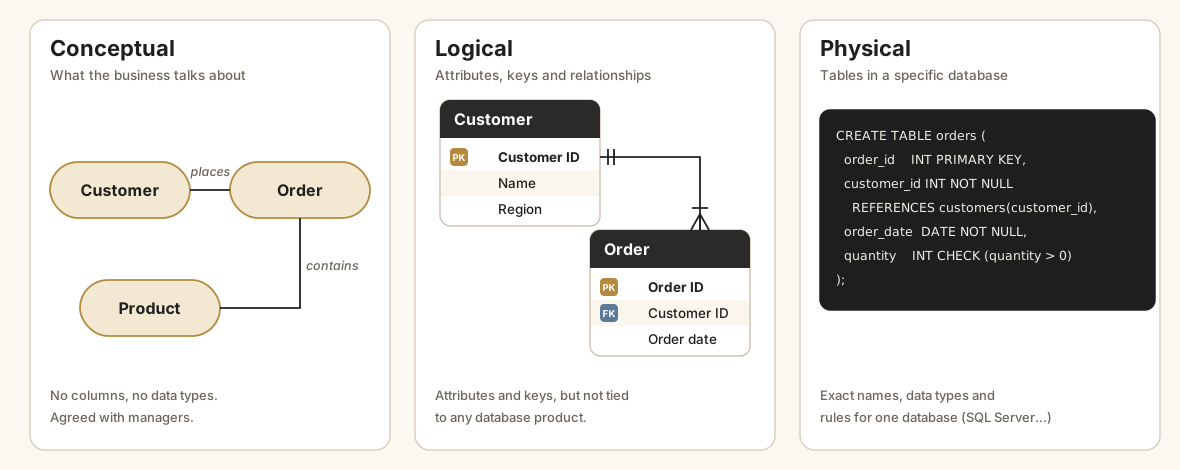
| Level | Describes | Who uses it | Kolanut example |
|---|---|---|---|
| Conceptual | The things the business cares about and how they relate | Managers and analysts agreeing scope | A customer places orders; an order contains products. |
| Logical | Each thing's attributes, its key, and the relationships with their cardinality | Analysts and designers | Customer (Customer ID, Name, Region); Order (Order ID, Customer ID, …); one customer to many orders. |
| Physical | Real tables in one specific database: names, data types, constraints, indexes | Database developers | CREATE TABLE orders (order_id INT PRIMARY KEY, …) in SQL Server |
Why it matters to an analyst
- Good models make questions easy: "revenue by region" is one join, not a cleaning project.
- Most "the numbers don't match" arguments come from models that store the same fact twice.
- In Power BI, the model is half the work: relationships decide what filters what.
Example
The Harbourline Freight database you've queried in the SQL course is a physical model with five tables. Its conceptual version fits in one sentence: employees look after customers; customers book shipments on routes; shipments are paid for by payments.
That sentence already contains the whole design: five entities (employees, customers, shipments, routes, payments) and four relationships (look after, book, on, paid for by). The next lessons turn sentences like this into tables, keys and lines.
Walkthrough
When you meet any database or dataset, recover its model in three questions:
- What are the things? Usually the nouns: customers, matters, invoices, employees.
- How do they connect? Usually the verbs: a client has matters; a matter has hearings.
- What identifies each one? An ID column, or a combination of columns.
Try it on Ashgrove Chambers, the law firm in the Power BI course: clients have matters; matters have hearings and invoices. Four things, three relationships, each identified by an ID (client_id, matter_id, hearing_id, invoice_id).
Practice
Practice
At which level of a data model do data types such as INT or DATE first appear? (One word.)
Practice
How many entities are there in this description? A school has teachers and students. Teachers teach classes; students enrol in classes; each class takes place in a classroom.
Check your understanding
Answer every question to check.