Module 5 · Data Modelling
Entity-relationship diagrams
Read and draw ERDs in crow's-foot notation, and use one to plan any query across several tables.
About 30 minutes
The problem
A new analyst at Harbourline is asked: "How much has each industry paid us?" The answer needs three tables: industry is on customers, payments are on payments, and the only connection between them is shipments. Without a map, the analyst guesses at joins. With an entity-relationship diagram (ERD), the path is visible in seconds.
The concept
An ERD draws a data model:
- a box per entity (table), listing its attributes (columns), with keys marked;
- a line per relationship, from a primary key to the foreign keys that point at it;
- line endings showing cardinality (crow's-foot notation).
Here is Harbourline's full ERD:
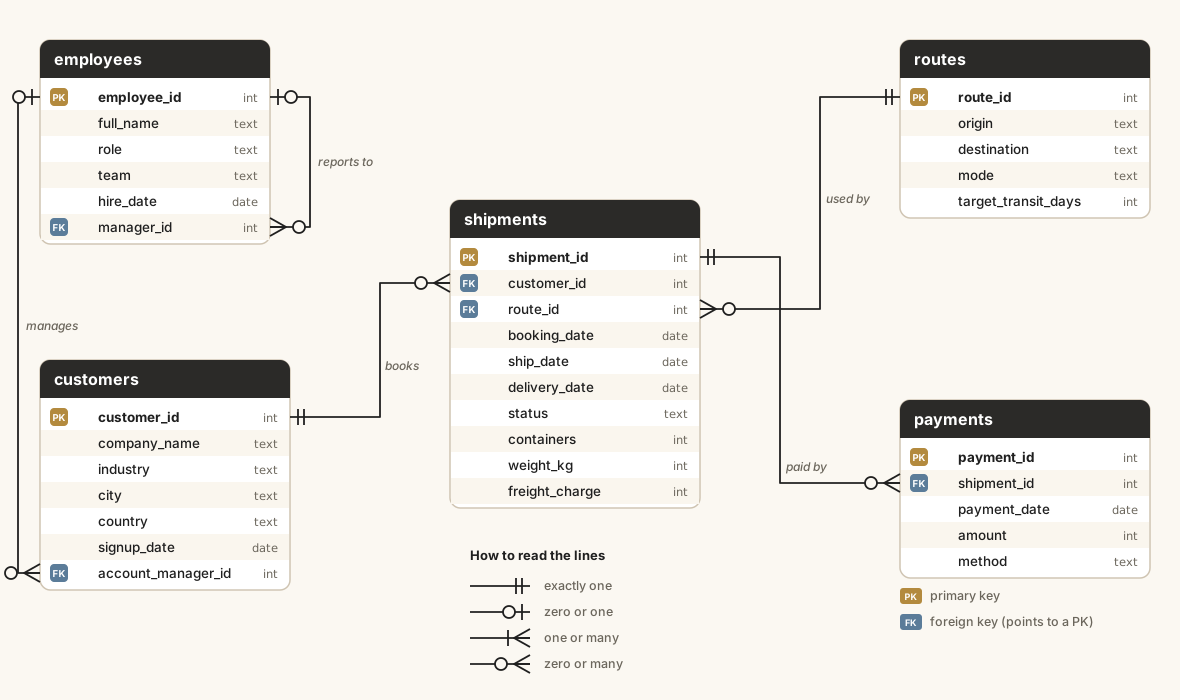
Reading one line, both ways. Take the line between customers and shipments:
- From customers: one customer books zero or many shipments (circle + crow's foot at the shipments end).
- From shipments: each shipment is booked by exactly one customer (two bars at the customers end).
A line back to the same table. employees.manager_id points to employees.employee_id: a self-relationship (each employee reports to zero or one manager). This is how organisation charts are stored.
Tools for drawing ERDs: draw.io (diagrams.net, free), dbdiagram.io, Lucidchart, Microsoft Visio, or the diagram features in SSMS, MySQL Workbench and Power BI's Model view. Paper works too; the notation matters more than the tool.
Example
"How much has each industry paid us?" On the diagram, walk from customers (industry) → shipments (via customer_id) → payments (via shipment_id). Each step is one JOIN:
SELECT c.industry, SUM(p.amount) AS total_paid
FROM customers AS c
JOIN shipments AS s ON s.customer_id = c.customer_id
JOIN payments  AS p ON p.shipment_id = s.shipment_id
GROUP BY c.industry
ORDER BY total_paid DESC;Walkthrough
Drawing an ERD from scratch, for Ashgrove Chambers:
- Boxes: clients, matters, hearings, invoices.
- Keys:
client_id,matter_id,hearing_id,invoice_idas primary keys. - Lines: clients → matters (a client has many matters: FK
matters.client_id); matters → hearings (FKhearings.matter_id); matters → invoices (FKinvoices.matter_id). - Endings: a matter must have one client (bars); a client may have zero matters (circle, crow's foot); a matter may have zero hearings (non-litigation work like contract review never goes to court).
- Check with a question: "Overdue amount per client" → clients → matters → invoices. Two joins, no gaps. ✓
You'll draw this ERD properly in the final project.
Practice
Practice
Follow the diagram: return each **route's origin** and the **number of payments** received for shipments on that route. Two columns, one row per origin.
Ctrl + Enter to run. Tab indents; press Esc then Tab to leave the editor.
Practice
Harbourline wants to record which employee packed each shipment (one packer per shipment). Which table gets the new foreign key column?
Check your understanding
Answer every question to check.