Module 4 · Data Modelling
Relationships and cardinality
One-to-one, one-to-many and many-to-many relationships, optional vs mandatory, and why many-to-many needs a bridge table.
About 30 minutes
The problem
At Harbourline, a shipment is usually paid in one go, but some customers pay in two instalments. If the model assumed "one payment per shipment", a payment_date column on shipments would have nowhere to put the second payment. Getting how many right, for each relationship, decides where every column goes.
The concept
Cardinality is how many rows on one side can relate to a row on the other.
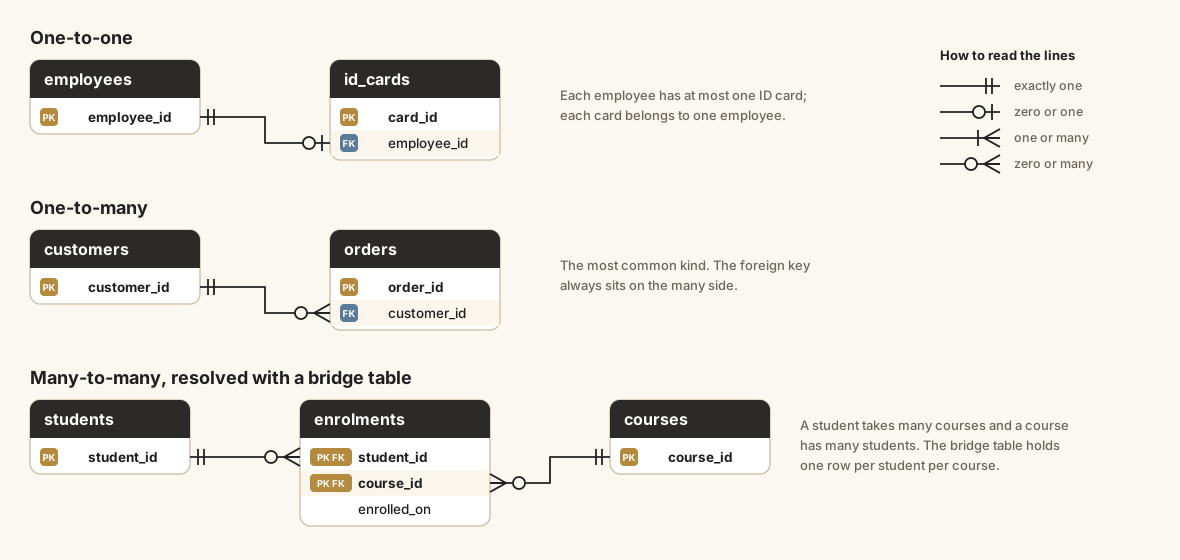
| Type | Meaning | Where the key goes | Harbourline / Kolanut |
|---|---|---|---|
| One-to-one | Each row matches at most one row on the other side | Either side, usually the optional one | An employee and their staff ID card |
| One-to-many | One parent row, many child rows | FK on the many side | A customer and their shipments |
| Many-to-many | Many on both sides | A bridge table holding both keys | Students and courses; products and suppliers |
Optional or mandatory. Each end also says whether a related row must exist:
- A shipment must have exactly one customer (mandatory, one).
- A customer may have zero shipments, if they've just signed up (optional, many).
In crow's-foot notation, a bar means "one", a crow's foot means "many", and a circle means "zero is allowed". The legend in the diagram shows all four endings.
Why many-to-many needs a bridge. You can't put course_id on the students table (a student takes several courses) or student_id on courses (a course has several students). So you create a table with one row per pairing, enrolments(student_id, course_id, enrolled_on), turning one many-to-many into two one-to-manys. The bridge often carries its own facts, such as the enrolment date or a grade.
Example
Harbourline's shipments-to-payments relationship is one-to-many, and optional on the payments side. How many payments do shipments have?
SELECT payments_per_shipment, COUNT(*) AS shipments
FROM (
  SELECT s.shipment_id, COUNT(p.payment_id) AS payments_per_shipment
  FROM shipments AS s
  LEFT JOIN payments AS p ON p.shipment_id = s.shipment_id
  GROUP BY s.shipment_id
)
GROUP BY payments_per_shipment
ORDER BY payments_per_shipment;
Some shipments have 0 payments (not yet paid, or cancelled), most have 1, and some have 2. The model has to allow all three, which it does because payments is its own table.
Walkthrough
For each pair of entities, ask two questions in both directions:
- Can one A have many Bs? and Can one B have many As?
- Yes / No → one-to-many (FK on B).
- Yes / Yes → many-to-many (bridge table).
- No / No → one-to-one.
- Must every A have a B? (mandatory or optional at each end)
Ashgrove Chambers, the law firm: can a client have many matters? Yes. Can a matter have many clients? In this data, no, so it's one-to-many and matters.client_id is the foreign key. (If the firm often acted for several clients jointly on one matter, it would need a matter_clients bridge.)
Practice
Practice
How many Harbourline shipments have **no** payment at all? Return one number.
Ctrl + Enter to run. Tab indents; press Esc then Tab to leave the editor.
Practice
How many shipments were paid in **exactly two** payments? Return one number.
Ctrl + Enter to run. Tab indents; press Esc then Tab to leave the editor.
Practice
A hospital: a doctor treats many patients, and a patient sees many doctors. What is the name for the extra table you need? (Two words.)
Check your understanding
Answer every question to check.