Module 2 · Business Analysis Fundamentals
Stakeholders
Find everyone affected by a change, map their power and interest, decide how to involve each one, and agree who does what with a RACI chart.
About 25 minutes
The problem
Six months ago, a Lagos firm bought a billing system its partners loved in a demo. The accounts officer, who would use it every day, was never asked. It couldn't print the paper invoices two of the firm's largest clients insisted on, so she kept the old spreadsheet running alongside it. Within three months the new system was abandoned.
Projects rarely fail because the analysis was too technical. They fail because someone who mattered was missed: a user who couldn't do their job, a manager who blocked it, a client who refused the new invoice format. Stakeholder analysis is how a BA makes sure everyone who matters is found and heard.
A story from the field: the parent who could not pay
A private secondary school in Abuja launched an online fees portal. The project team included the principal, the bursar and an IT contractor. They tested the portal carefully with the people in that room, and it worked beautifully.
On launch day, collections did not rise. They fell. Within a week the principal was receiving angry calls.
What had gone wrong? The analyst brought in to investigate drew a list of everyone the portal touched. The team had thought about three groups: the principal, the bursar and the contractor. The list now had eleven. Two of the forgotten groups mattered most. The first was the parents, many of whom did not have smartphones or card payments and used to pay cash at the school gate to a clerk they knew. The second was that clerk, whose job the portal quietly removed, and who had been telling parents the portal "does not work".
Nobody had asked the parents or the clerk a single question. Because they had no say in the design, they had every reason to resist it.
The fix was not technical. The school added a way to pay in cash and have it entered in the portal by the clerk. The clerk became the portal's champion, and collections rose above where they had started.
The lesson: people who are affected but not asked will find a way to be heard, usually at the worst moment. A good analyst makes the list of stakeholders before designing anything.
The concept
Who counts as a stakeholder
Anyone who affects the change or is affected by it: the people who'll pay for it, use it, run it, support it, or be on the receiving end of it. Look in four directions:
- Up: sponsors and decision-makers (the managing partner).
- Across: the people who do the work today (lawyers, paralegals, the accounts officer).
- Out: customers and suppliers (clients, the software vendor, the bank).
- Around: support and control (IT, the auditor, regulators such as the data protection authority).
The power and interest grid
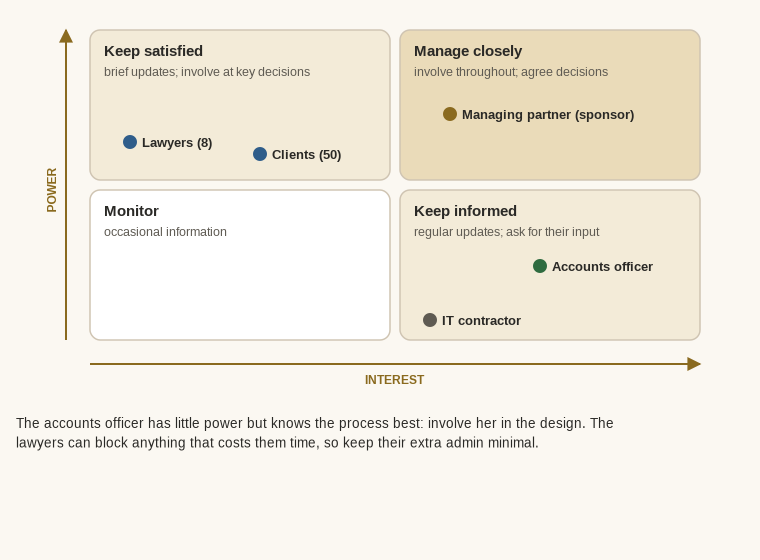
Place each stakeholder on two scales: their power over the change and their interest in it.
| Low interest | High interest | |
|---|---|---|
| High power | Keep satisfied: brief updates, involve at key decisions | Manage closely: involve throughout, agree decisions with them |
| Low power | Monitor: occasional information | Keep informed: regular updates, ask for their input; they often know the details best |
The people who do the work every day often sit in "keep informed", but their knowledge is essential, and their resistance can sink a project. Don't confuse low power with low importance.
RACI: who does what
For each key decision or deliverable, a RACI chart says who is:
- Responsible: does the work.
- Accountable: owns the outcome and signs off. Exactly one person per row.
- Consulted: asked for input before (two-way).
- Informed: told after (one-way).
Example
Part of Ashgrove's stakeholder register:
| Stakeholder | Role in the change | Power | Interest | Approach |
|---|---|---|---|---|
| Mrs Adeyemi-Cole, managing partner | sponsor, approves the budget | high | high | manage closely: weekly 15-minute update |
| Accounts officer | issues and chases invoices today | low | high | keep informed, and involve in design: she knows the process best |
| Lawyers (8) | record work and approve bills | medium | low | keep satisfied: short demos, minimal extra admin |
| Clients (50) | receive and pay invoices | medium | medium | consult a few major clients on the invoice format |
| IT contractor | supports the current spreadsheets | low | medium | consult on data migration |
And a RACI row: Approve the new invoice process: Responsible, BA; Accountable, managing partner; Consulted, accounts officer and two senior lawyers; Informed, all staff.
A real-world scenario: the traders' cooperative
A market traders' cooperative in Onitsha wants a simple system for collecting monthly dues and giving members receipts. You are the analyst. Before talking about software, you map the stakeholders.
First, brainstorm everyone affected. Then sort them by power (can they stop or change the project?) and interest (do they care about the result?).
| Stakeholder | Power | Interest | How to involve them |
|---|---|---|---|
| Chairman of the cooperative | High | High | Manage closely: decisions, sign-off |
| Treasurer | Medium | High | Work with daily: the process owner |
| Ordinary members (traders) | Low | High | Keep informed and consult by short interviews |
| Market union leaders | High | Low | Keep satisfied: short briefings, no surprises |
| Bank handling the account | Medium | Low | Consult on what is possible |
| Older traders who do not use phones | Low | High | Interview in person, design for them |
Notice the last row. It is the group a rushed team forgets, and it is the group that breaks a launch (as in the school story).
Practical steps for any project:
- List stakeholders by name and role, not just "the business".
- Place each on the power and interest grid.
- Decide how you will engage each one, and how often.
- Ask each of the high-power people: "What would make this a success for you?" Write their answers down. They often conflict, and it is much cheaper to find that out on day one.
Walkthrough
- List everyone affected by a change to Ashgrove's billing, looking up, across, out and around.
- Place each one on the power and interest grid. Be honest about the lawyers: their interest in billing admin is probably low, but they can block anything that costs them time.
- Use the matters data to see who carries the most open work. The busiest lawyers will have the least time for new billing steps.
- Write an approach for each stakeholder (the task below).
- Draft a RACI for three decisions: choosing the solution, designing the new invoice, and switching off the spreadsheets.
Practice
Practice
Which lawyer is responsible for the most Open matters? Type their name.
Task
8 minWrite a stakeholder register for Ashgrove's billing change with at least five stakeholders. Put each on its own line starting with -, in the form Stakeholder | Power | Interest | Approach, where power and interest are high, medium or low.
Your work is checked for
- At least five stakeholders, each a line starting with -
- Each line has four parts separated by |
- Power and interest given as high, medium or low
- Includes the people who do the billing work (accounts officer or paralegals)
- Includes clients
Check your understanding
Answer every question to check.