Module 1 · AI Productivity Fundamentals
A Complete Worked Example: Planning a Promotion with AI
Follow one real task from start to finish: a juice-shop owner plans a Friday promotion with an AI assistant, using the prompt framework, follow-ups, a hand check of the numbers and a critique step, so you can copy the whole pattern for your own work.
About 25 minutes
A story to start: Funmi's slow Fridays
Funmi sells fresh zobo, kunu and chapman from a small shop near the University of Ibadan. Friday should be her best day, because students are paid or have just received allowances. But last month her Fridays were only average, and a new shop had opened down the road.
She has a free hour on Thursday evening and a goal: bring in more customers on Friday without losing money. She has never used AI for business. In this lesson you will watch her do it, step by step, and then do the same on your own task. Every part of this example is something you can copy.
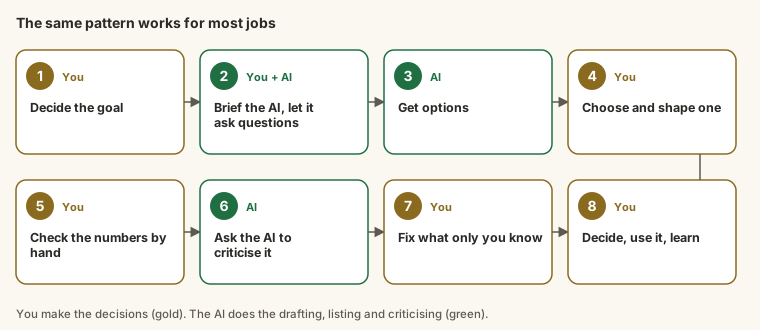
The pattern to notice: you decide the goal and make the final call; the AI drafts, lists options and criticises. You are the manager, the AI is a fast assistant.
Step 1: Funmi decides the goal (no AI yet)
Before opening any tool, Funmi writes down what she wants, in numbers if possible. This is the step most people skip, and it is why their AI results feel random.
Output
Goal: more customers on Fridays, without losing money.
Normal Friday: about 60 bottles of zobo (50cl) at ₦500 each.
Cost to make one bottle: ₦300. So I earn ₦200 on each.
Budget for promoting: ₦5,000 at most.Notice she already knows something the AI cannot: her own prices, costs and budget. That is her contribution.
Step 2: She briefs the AI and lets it ask questions
Funmi uses the framework from the last lesson. She also uses the "check" step: asking the AI to question her first.
Output
ROLE: Act as a friendly small-business marketing coach.
CONTEXT: I run a juice shop near the University of Ibadan. Customers are
mostly students. On a normal Friday I sell about 60 bottles of zobo (50cl)
at ₦500 each. Each bottle costs me ₦300 to make. A new juice shop opened
down the road last month.
TASK: Help me plan a promotion for Fridays to bring in more customers.
RULES: My promotion budget is ₦5,000 at most. I must not lose money on
the promotion. Do not suggest anything that needs an app or a website.
CHECK: Before you suggest anything, ask me up to 4 questions.A typical reply:
Output
Happy to help! A few questions first:
1. Do customers usually come alone or in groups?
2. Do you already have a WhatsApp group or status audience?
3. Is zobo your best-selling drink, or could another drink anchor the offer?
4. What time of day on Friday is your quietest?The AI did not guess. It asked for the facts it was missing. Funmi answers in one message:
Output
1. Mostly small groups of friends. 2. Yes, about 220 contacts on
WhatsApp status. 3. Zobo is the best seller. 4. Quietest 2pm to 5pm.Step 3: The AI gives options, not a single answer
Now Funmi asks for a range to choose from.
Output
Thanks. Give me 4 different promotion ideas for Friday. For each one:
the offer, why it fits my situation, the cost to me, and one risk. Put
them in a table.A typical reply (shortened):
| Idea | Offer | Why it fits | Cost to you | Risk |
|---|---|---|---|---|
| 1. Group bundle | Buy 3 zobo for ₦1,200 instead of ₦1,500 | Customers come in groups | You earn ₦100 less per bottle | Margin drops sharply |
| 2. Quiet-hours deal | Free small kunu with any zobo between 2pm and 5pm | Fills your quiet window | Cost of the small kunu | Customers may only come for the free item |
| 3. Loyalty card | Buy 5 zobo, get the 6th free | Brings people back each week | One free bottle per 6 | Slow to pay off |
| 4. Status countdown | Post a Friday status with a "first 20 customers" bonus | Uses your 220 contacts, free | Almost nothing | Needs you to post on time |
Look at how useful this is. Funmi would have thought of one or two of these alone. Now she has four, with trade-offs.
Step 4: She chooses one and shapes it
Funmi likes idea 1 (the group bundle) combined with idea 4 (the status post). She now tells the AI her decision, because choosing is her job.
Output
I like idea 1 combined with idea 4. Draft the exact offer: buy 3 zobo for
₦1,200, for the first 20 groups on Friday, between 2pm and 5pm only.
Then write the WhatsApp status message to announce it. Under 35 words,
friendly, no emojis, and do not promise anything beyond the offer.A typical reply:
Output
OFFER: Buy 3 zobo (50cl) for ₦1,200 on Friday, 2pm-5pm. First 20 groups only.

STATUS MESSAGE:
This Friday, 2pm-5pm: any 3 zobo for ₦1,200 instead of ₦1,500. First 20
groups only. Bring your friends and come early.Step 5: She checks the numbers by hand
This is the step that protects Funmi. The AI never calculated whether the offer makes money; it only wrote words. So she does the maths herself.
- A bundle of 3 costs her 3 × ₦300 = ₦900 to make, and sells for ₦1,200.
- Profit per bundle = ₦1,200 − ₦900 = ₦300.
- Normally, 3 bottles at ₦500 give ₦1,500, a profit of ₦600.
- So per bottle, the bundle earns ₦100 instead of ₦200: half as much profit.
A normal Friday gives about 60 × ₦200 = ₦12,000 profit on zobo. At ₦100 per bottle, she would need to sell 120 bottles just to earn the same ₦12,000. The offer is only worth it if it brings a lot of new customers.
If Funmi had trusted a vague "this will boost sales" from the AI, she might have given away her profit without noticing.
Step 6: She asks the AI to criticise the plan
Now she uses the AI differently: as a critic.
Output
Act as a cautious business advisor. Here is my plan: [the offer and the
numbers above]. Find the three biggest weaknesses and suggest a fix for
each. Be direct.A typical reply:
Output
1. Margin is halved. Fix: limit the offer to 2pm-5pm (already done) and
   cap it at 20 groups so total discount cost is limited.
2. Customers may buy the bundle instead of buying at full price later in
   the day. Fix: make it a "quiet hours only" offer and say so clearly.
3. No way to measure whether it worked. Fix: count bundles sold and
compare Friday sales to your last three Fridays.These are useful. She would not have thought of number 3.
Step 7: She fixes what only she knows
The AI's advice is generic in one place: it suggested capping at 20 groups. Funmi knows her shop. At 2pm to 5pm she has one person serving and 20 bundles of 3 bottles means 60 bottles, which is too much for one person in three hours. She changes it to 12 groups.
Then 12 bundles × ₦300 profit = ₦3,600 profit from the offer. And she wants to count how many of those buyers are new customers, so she decides to ask each group, "Is this your first time here?" and note it.
This is the "human in the loop" part. The AI could not know about her one-person counter. She did.
Step 8: She decides, uses it, and learns
On Thursday evening she posts the status, set to go out Friday at 1:30pm. On Friday she sells 11 bundles, and six of the groups say it is their first time. On Saturday she asks the AI:
Output
Here is what happened: 11 bundles sold, 6 groups were new customers.
Normal Friday profit is ₦12,000 on zobo. Offer profit was ₦3,300. Help me
decide whether to repeat it, change it, or drop it. Ask me questions first.She now has real data to decide with, which is the best use of any tool: it helps her learn, not just write.
What to copy from this example
- Decide the goal and know your numbers before opening the AI.
- Brief it with the framework and let it ask questions.
- Ask for options, not one answer.
- You choose, then shape the choice.
- Check the maths by hand.
- Ask the AI to criticise the plan.
- Fix what only you know.
- Decide, act, and learn from the result.
Try it
Practice
Funmi earns ₦100 profit per bottle on the group bundle, and normally earns ₦12,000 on a Friday from zobo. If she only sold bundles, how many bottles would she need to sell to earn that same ₦12,000?
Task
8 minNow do it for your own situation. Pick a real goal (a promotion, a study plan, a work report, a job application, a trip) and write the first prompt you would give an AI, using the framework. It must state your goal, give context with at least one real number or date, set a rule, and ask the AI to ask you questions first.
Your work is checked for
- Sets a role (act as, you are…)
- Gives context (I, my, our…) with at least one number or date
- States a task with a verb (plan, write, draft, help, list…)
- Sets at least one rule or limit (budget, under N words, must not…)
- Asks the AI to ask questions first
- Long enough to be a real brief (at least 55 words)
Task
5 minIn the example, Funmi did two things the AI could not do for her. Name two of them and explain why each mattered.
Your work is checked for
- Two separate points
- Mentions checking or calculating the numbers by hand
- Mentions her own knowledge or decision (one person, her shop, decided, chose, knew…)
- Explains why it mattered (because, so, otherwise, which meant…)
Earn your badge
Take the module check
Questions on this module. Pass and you earn the Prompting Essentials badge, free.
Create a free account to earn the badge